
How to become an F&I manager, even if you’ve never sold a car
There’s no single license or degree that gets you into the finance office. Here are the three common paths in, what hiring managers look for, and a step-by-step plan to get ready.
Camila VenegasUpdated October 20267 min read

Most F&I managers earn the job by proving themselves inside a dealership first, usually on the sales floor, then learning the finance side and asking for the seat. No universal license or degree is required, but some states license specific activities, and most dealerships want to see dealership experience before they hand you the F&I office.
What an F&I manager does
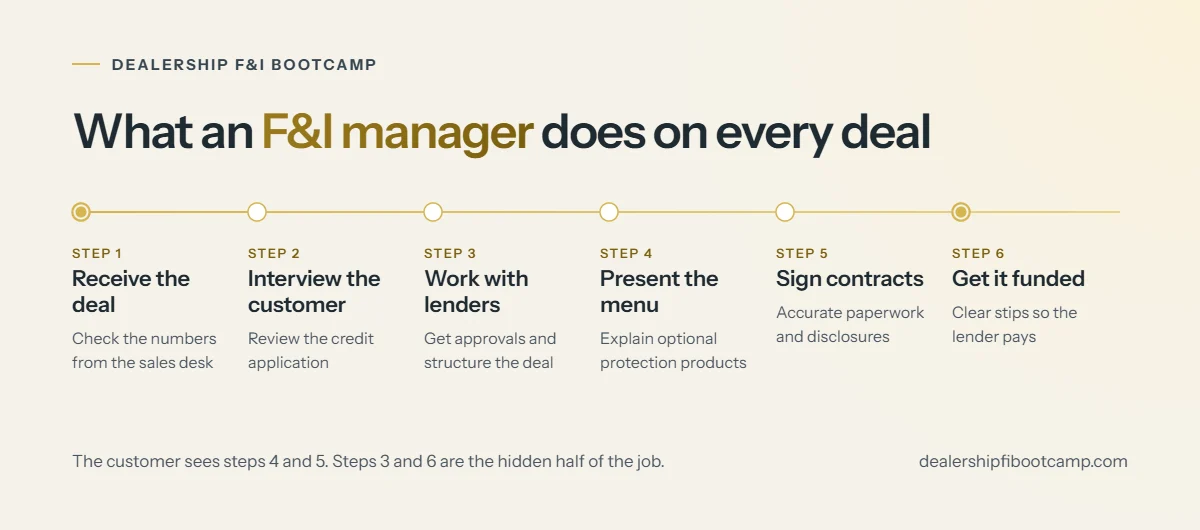
F&I stands for finance and insurance. The F&I manager, sometimes called the finance manager or business manager, takes a customer who has agreed to buy a vehicle and turns that agreement into a funded deal. That means arranging the financing with a lender, presenting optional protection products such as service contracts and GAP, completing the contract and documents, and following the deal until the lender actually pays the dealership.
It’s a detail job wrapped in a people job. You’ll work with customers, salespeople, sales managers, lenders and the office staff, often on evenings and weekends. If you want the full picture, read what an F&I manager actually does all day.
I’ve spent 17 years in the car business, more than 12 of them in the F&I chair at Lexus and Nissan stores and as a virtual F&I manager. The part customers never see, the lender calls, the stips and the paperwork that must be perfect before the bank pays, is where new F&I managers struggle most.
Do you need a license, degree or certification?
This is the first question most people ask, and the honest answer has three parts.
- Degree: not usually. Some job postings list a college degree as preferred, but most dealerships care more about dealership experience, comfort with numbers and sound judgment.
- License: there’s no single nationwide F&I license. Licensing depends on your state and on what you sell. For example, selling credit insurance can require a state insurance license. Check with your state’s insurance department and your dealership before you start.
- Certification: voluntary industry certifications exist, such as the compliance certification offered by the Association of Finance and Insurance Professionals (AFIP). Some employers value them. None is universally required to be hired.
- Background checks: most dealerships run a criminal background check, a driving record check and a drug test before hiring, and some check credit. Be upfront about anything that might come up.
- Experience: many F&I job ads ask for 2–3 years of F&I or dealership experience. That’s why most first chances come from a promotion inside a dealership, or at a smaller or independent store.
The three paths into the F&I office
People reach the finance office from three directions. Knowing which one you’re on tells you what to work on next.
| Path | Who it fits | What it usually takes |
|---|---|---|
| 1 · From the sales floor | Salespeople with steady numbers and good customer scores | Consistent production, learning the finance side on your own time, then asking for the seat. This is the most common route. |
| 2 · From another dealership job | Title clerks, office staff, BDC and finance assistants, desk managers | Your paperwork and funding knowledge is a real head start. You add the customer-facing skills: the interview, the menu and objections. |
| 3 · From outside the car business | People from banking, lending, insurance or other sales jobs | Your skills transfer, but many stores still want you to learn the dealership first, often on the sales floor or as a finance assistant. |
If you’ve never worked in a dealership, path three is real but slower. Be ready to start one step away from the F&I office and to treat that job as your training ground.

What hiring managers look for
General managers aren’t just hiring someone to sell products. They’re trusting you with the store’s money, its lender relationships and its compliance record. In interviews, they listen for these:
- You understand the whole deal, from the sales turnover to the day the lender funds it.
- You’re comfortable with numbers: payments, terms, rates and how a deal is structured.
- Your paperwork is clean, because a missing signature can hold up funding for days.
- You can explain a product simply and honestly, without fear tactics.
- You hold the line on ethics when a customer or a manager pushes you to cut a corner.
- You stay calm when three deals are waiting and everyone wants theirs done first.
A step-by-step plan to get ready
- Learn the deal from turnover to funding. Every F&I interview eventually asks you to walk through a deal. Start with our free F&I Deal Map, which lays out all 18 steps on one page.
- Learn the language. Buy rate, sell rate, stip, callback, CIT, PVR, penetration. If you can use these words in a sentence, you’ll sound like you belong in the room.
- Get close to the office. If you work at a dealership, ask the F&I managers if you can sit in on turnovers or watch how they clear stips. Ask why deals get structured the way they do.
- Build an F&I résumé. Lead with numbers: units a month, closing ratio, customer satisfaction scores. Show that you track your results and understand the finance side.
- Practice the interview out loud. Expect questions about the deal process, the menu and ethics. Start with the seven questions you’ll hear in an F&I interview.
- Ask, or apply. If you’re at a dealership, ask your GM for a path into the office. Here’s how to ask your GM for the seat. If the answer is no, take your new résumé to other stores.
The math lenders check on every deal
Lenders look at three numbers on almost every deal. Learn them before your interview:
- PTI (payment-to-income): the new car payment ÷ gross monthly income.
- DTI (debt-to-income): all monthly debt payments, including the new car payment ÷ gross monthly income.
- LTV (loan-to-value): amount financed ÷ the vehicle value the lender uses.
Example: a customer earns $5,000 a month before taxes, pays $1,200 a month in rent and other debts, and the new car payment is $600. PTI is $600 ÷ $5,000 = 12%. DTI is ($1,200 + $600) ÷ $5,000 = 36%. Each lender sets its own limits, so the same deal can be approved by one bank and declined by another.
Learn the rules, too
Compliance is part of the job from day one. Key federal rules include the Truth in Lending Act, the Equal Credit Opportunity Act, the Fair Credit Reporting Act, the FTC’s Safeguards and Red Flags Rules, and OFAC checks, plus your state’s laws. The FTC’s CARS Rule was formally withdrawn in February 2026, but the FTC still acts against deceptive pricing. In March 2026 it warned 97 dealership groups about hidden fees and required add-ons.
How long does it take?
There’s no standard timeline. It depends on whether your store has an opening, how strong your track record is and how prepared you are when a seat opens up. What you control is the last part: when the chance comes, be the person who already knows the deal, the language and the products.
3 myths about becoming an F&I manager
- “Every state requires an F&I license.” No. There’s no national F&I license; what you need depends on your state and what you sell.
- “F&I is just selling warranties.” Products are one part. Most of the job is credit, lenders, contracts, funding and compliance.
- “A certificate guarantees a job.” Training prepares you. Hiring depends on the dealership, your interview and your experience.
Before you accept an F&I offer
Most F&I pay plans are built mainly on commission, so ask to see the pay plan in writing and read three things: how gross profit is defined, what the chargeback language says, and whether any bonus depends on compliance or customer satisfaction. For what the job actually pays, see how much F&I managers make.
Frequently asked questions
Can you become an F&I manager with no experience?
Yes, but rarely straight from outside the car business. Most dealerships want to see dealership experience first, so the most common route is to start in sales or another dealership role, learn the finance side, and move up when a seat opens.
Do I need to be good at math?
You need to be comfortable with numbers, not a mathematician. The software does the calculations, but you have to understand how price, down payment, term and rate change a payment, and spot when a number doesn’t look right.
Is an F&I certification required?
No single certification is required nationwide. Voluntary certifications, like AFIP’s, can show employers you take compliance seriously. Separately, your state may require a license for certain products, such as credit insurance.
Is F&I a good career?
It can pay well, but income varies widely by store, pay plan and performance, and the hours are long. It suits people who like detail, numbers and working with customers, and who are comfortable with commission pay.